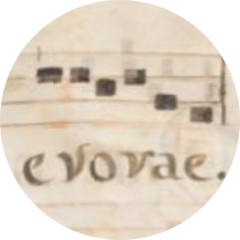
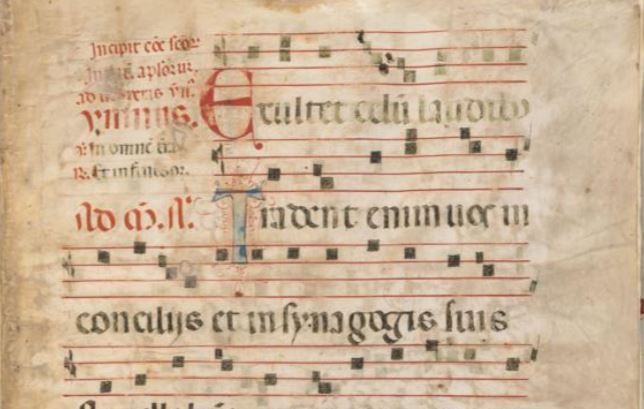
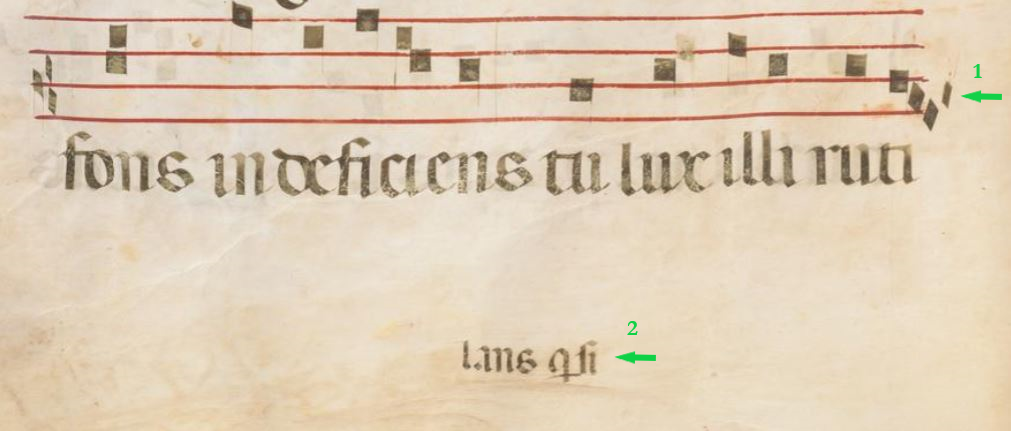
Barnard 1 is a 14th century Franciscan Antiphonal1 from Siena.* The manuscript is written on parchment and consists of 154 folios (in 19 quires), paginated in a later hand. The bifolia are constructed of single folded leaves, and catchwords can be found on the lower margin at the end of every quire.
Each page contains 7 lines of text and music (except for the last two quires, which have 8 lines of text and music per page) written in a formal gothic liturgical hand. The music is in square block notation on 4-line red staves with ‘custos’2 at the end of each row.
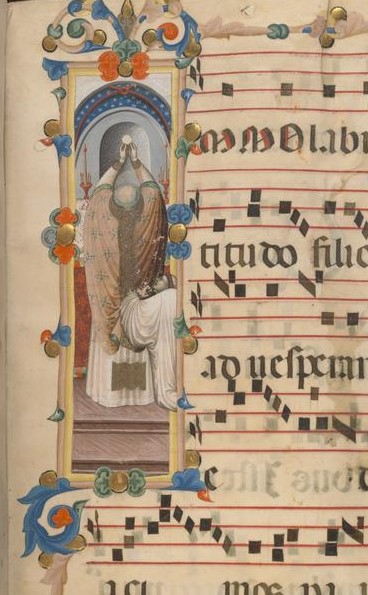
The manuscript includes four historiated initials attributed to Niccolò di Ser Sozzo: Consecration of the Host for the Feast of Corpus Christi (p. 189, left), Death of Francis for the vespers service of the Feast of the Translation of Francis (p. 211), Stigmata of Francis for the responsory to the Feast of Francis (p. 220), and Anthony holding book for the Feast of Anthony of Padua (p. 253). Apart from the first, these initials show signs of damage, possibly from devotional touching. There are also painted initials for antiphons at lauds and vespers and for the responsory at first nocturn (below, left) and minor initials for other chants (below, right).
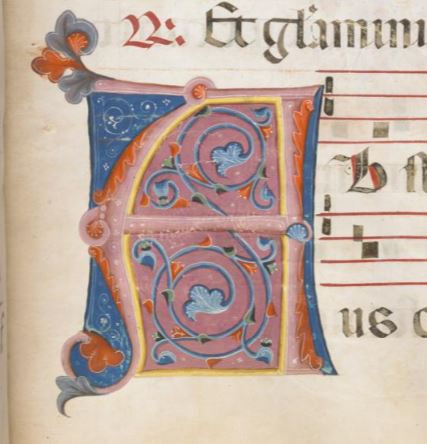
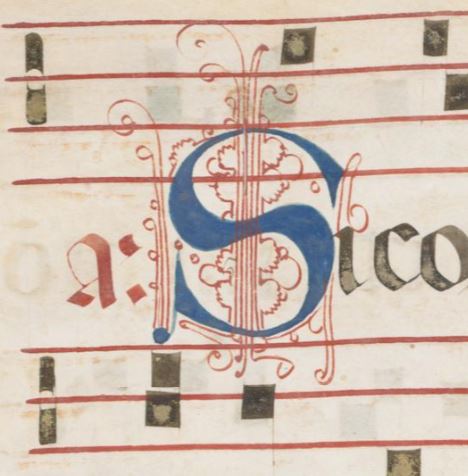
The manuscript also contains several liturgical additions in an early modern hand, and fragments of a table of contents in a late 18th century hand. It is with these later materials that we can begin our research into the history of Barnard 1.
- An antiphonal (from a Greek word meaning ‘sung in response’) is a liturgical book used for the divine office that includes antiphons, short verses sung with the psalms and canticles, and responsories of Matins and Vespers. For more, see Singing the Antiphonary, an exhibit by Pablo Alvarez at the University of Michigan.
- The Latin word for “guard,” a custos is a small note at the end of a line that indicates the note that will follow.
*This description borrows heavily from the description done by Consuelo Dutschke, 12 January 1998.
